
All You Need to Know About Hyaluronic Acid
If there’s one skincare ingredient that’s earned its “holy grail” reputation, it’s hyaluronic acid (HA). We’ve seen it in products such as serums, moisturisers, and face masks. All promising glowing, dewy skin — and it delivers.
But HA isn’t a beauty fad.
It’s a naturally occurring molecule in our bodies that help keep our skin plump, joints lubricated, and tissues resilient. It acts as our body’s own hydration magnet that’s capable of holding up to 1,000 times its weight in water.
Our natural HA levels decline with age. Combined with sun exposure, stress, and lifestyle, there’s gradual loss of HA in our bodies. The result? Dryness, fine lines, and diminished skin elasticity. The good news is that you can reverse these signs of ageing. With the right skincare, nutrition, and lifestyle habits, you can boost your HA levels and give your skin a noticeable lift from the inside out.
What Is Hyaluronic Acid?
Hyaluronic acid, also called hyaluronan, is a naturally occurring sugar molecule known as glycosaminoglycan (GAG). It is made of repeating units of two sugars: D-glucuronic acid and N-acetyl-D-glucosamine. All the hype lies in its ability to attract and hold water, keeping tissues hydrated and plumped up.
HA is found in many parts of our bodies — the skin, connective tissues, cartilage, synovial fluid in joints, and even in our eyes. In the skin, it helps maintain volume, elasticity, and soft, youthful glow. In joints, it acts as a lubricant and shock absorber, while in our eyes, it gives them shape and moisture.
Is Hyaluronic Acid Naturally Produced in the Body?
Yes — our bodies synthesized HA through enzymes known as hyaluronan synthases (HAS). There are three main types: HAS1, HAS2, and HAS3, each slightly different in how and where they work. These enzymes build chains of HA and release them into the extracellular matrix (ECM), the skin’s structural network, where HA hydrates and plumps up our skin.
However, HA production naturally slows down as we age. When HA levels dip, it contributes to skin dryness, sagging, wrinkles, and a loss of elasticity.
Functions of Hyaluronic Acid
HA isn’t just for surface hydration; it plays multiple roles in maintaining healthy skin layers:
- Hydration and Moisture Retention: HA draws water into the skin and connective tissues to keep skin plump and smooth.
- Structural Support: As a key component of the ECM, HA acts like a scaffold to support cells and tissues. This is critical for skin elasticity, connective tissue strength, and resilience.
- Tissue Repair and Inflammation Modulation: HA helps tissue heal by facilitating cell migration and growth. Smaller HA fragments also act as signaling molecules to calm inflammation and repair damaged tissues.
- Joint and Eye Health: In our eyes, HA lubricates and cushions joints while maintaining the shape and moisture.
How Hyaluronic Acid Breaks Down
Hyaluronic acid breaks down via the following mechanism:
1. Enzymatic Degradation
Special enzymes called hyaluronidases act like tiny scissors that cut HA chains into smaller fragments to remove old or damaged molecules. Two primary enzymes work together:
- HYAL2: Starts on the cell surface, cutting large HA molecules into smaller fragments.
- HYAL1: Works inside cells and in the bloodstream, breaking these fragments down further.
This degradation keeps HA levels balanced, allowing the skin and connective tissues to their elasticity, resilience, and reparation. It also regulates how cells grow and interact within the ECM.
2. Free-Radical (Non-Enzymatic) Degradation
HA can also be broken down by free radicals. Molecules produced by UV light, pollution, and normal metabolism damages HA, leading to dryness, sagging, and fine lines. Protecting your skin from environmental stressors with sunscreen, antioxidants, and a balanced lifestyle helps preserve the hyaluronic acid in our skin.
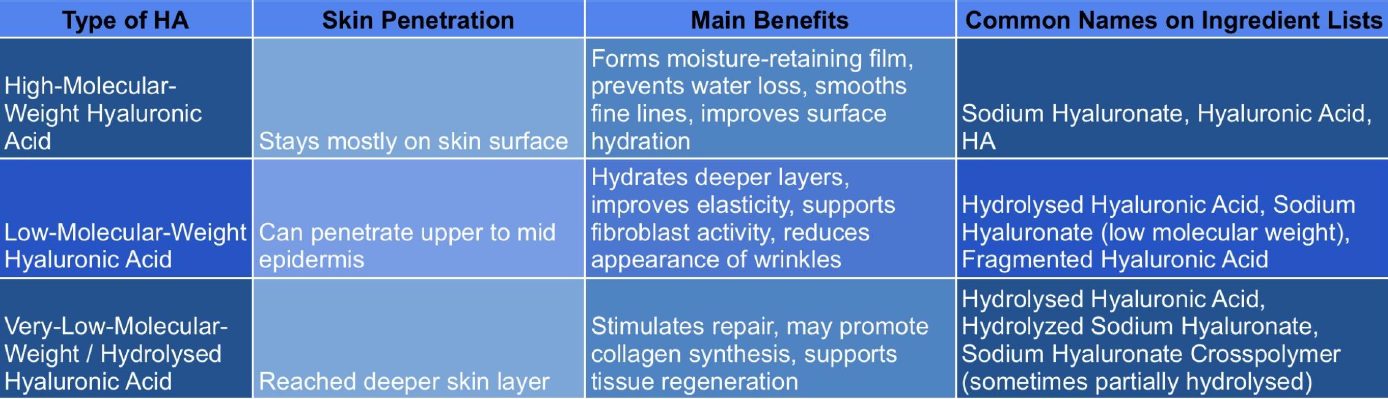
Not all HA is the same. Skincare products often use different molecular weights to target specific skin concerns and dermal layers:
High-Molecular-Weight Hyaluronic Acid
These large molecules mostly stay on the surface of our skin. They form a moisturising protective film to smooth fine lines, and strengthen our skin barrier. They are more commonly known as Sodium Hyaluronate, Hyaluronic Acid.
Read more about Skin Barrier here.
Low-Molecular-Weight Hyaluronic Acid
These are smaller molecules that penetrate into deeper skin layer to hydrate our skin from within and increases collagen production. It is usually listed as Hydrolysed Hyaluronic Acid or Fragmented Sodium Hyaluronate.
Very-Low-Molecular-Weight Hyaluronic Acid
Hyaluronic Acid with ultra-small molecules reaches below the top skin layer to act as cellular messengers. It promotes skin cell reparation and calms inflammation that is resulted from dehydration sensitivities. You can look out for Hydrolysed HA or Nano HA on the product labels.
Foods That Support Hyaluronic Acid Production
You can also boost HA naturally through diet:
- Bone broth as it is rich in proline and glutamine for HA synthesis.
- Vitamin C foods such as citrus fruits, berries, bell peppers support collagen and HA production.
- Soy products contains Isoflavones help maintain hydration.
- Leafy greens provide magnesium and cofactors for HA synthesis.
- Nuts and seeds are rich in vitamin E, healthy fats, and minerals for skin health.
- Root vegetables contain antioxidants protect HA from free-radical damage.
Hyaluronic acid is more than a trendy skincare ingredient — it’s a critical molecule for hydration, structure, and repair in your skin and tissues. While natural production declines with age and environmental stress, targeted skincare, nutrition, and lifestyle choices can help maintain optimal HA levels. Choosing the right type of HA for your needs — whether for surface hydration, deep dermal support, or long-term firmness — allows you to keep your skin plump, resilient, and radiant. Combine topical treatments with HA-supporting foods and protective habits, and your skin will thank you with a natural, youthful glow.
References
- De Tollenaere M et al. High molecular weight hyaluronic acid vectorised with clay provides long-term hydration and reduces skin brightness. Skin Research and Technology. 2024;30(4):e13672. doi:10.1111/srt.13672. https://pubmed.ncbi.nlm.nih.gov/38591218/?utm_source=chatgpt.com
- Lain E et al. Clinical evaluation of next-generation, multi-weight hyaluronic acid for skin rejuvenation. Journal of Cosmetic and Aesthetic Dermatology. 2024. https://jcadonline.com/clinical-evaluation-hyaluronic-acid-skin-rejuvenation/?utm_source=chatgpt.com
- Chun C. Effect of molecular weight of hyaluronic acid on its properties. Biomaterials Research. 2016;20:26. https://biomaterialsres.biomedcentral.com/articles/10.1186/s40824-016-0073-3?utm_source=chatgpt.com
- Micheels P. Clinical perspectives on the injectability of cross-linked hyaluronic acid dermal fillers. PMC. 2024. https://pmc.ncbi.nlm.nih.gov/articles/PMC10888303/?utm_source=chatgpt.com
- Chylińska N. Hyaluronic Acid and Skin: Its Role in Aging and Wound Healing. Polymers. 2025;11(4):281. https://www.mdpi.com/2310-2861/11/4/281?utm_source=chatgpt.com